

Friday, July 13, 2012
Can I Use Real Sports Teams in Novel

Thursday, July 12, 2012
Wants to Use Ladies in Pool Picture
 |
| my mom as a teenager |
What about the copyright exception for photos of women in swimsuits? Because of the immense popularity of photos of women in swimsuits, male lawmakers in 1983 created an exception to copyright law known as the Anderson Rule (named after Baywatch star, Pamela Anderson), which permits limited reproductions of photographs of swimsuit-clad women if the use is not-for-profit and proper attribution is provided. (After a case was brought by Victoria's Secret, it was established that the rule does not apply to women in lingerie.) Following an outburst by women's groups, the Anderson rule was expanded in 1987 to include men, as well. Of course, none of this is true but we just wanted to keep you on the page as long as possible to improve our SEO.
Wednesday, July 11, 2012
Wants to Use Victorian Paper Scraps

Why don't we believe these scraps are protected by copyright? According to this site, Victorian paper scraps appeared at the beginning of the 19th Century initially in black and white or color (if hand-tinted). Color printing of these scraps began in the late 1930's. Because of these dates, chances are very strong that these works are in the public domain (see this chart for more details) either because copyright expired or was never renewed. In any case, determining whether copyright exists is an academic exercise as your use is permitted by the first sale doctrine and does not violate copyright law.

Tuesday, July 10, 2012
Wants to Leave Copyright to Son

Monday, July 9, 2012
Working With Developmental Editor

The Author’s commitment to maintaining the confidentiality of Company’s Confidential Information shall not extend to information the Author already possessed at the time of disclosure by Company, information which is in or subsequently becomes public domain, whether through release by Company or through a source other than the Author.
Company understands that the Author will share information about the Author’s work, including, but not limited to, draft manuscripts and/or concepts for a book or books (hereafter “Author’s Confidential Information”) with Company during Author’s dealings with Company. Company agrees to keep Author’s Confidential information confidential, except as necessary to provide services to the Author.I wanted to know if that’s all I need for an initial meeting with a book development editor.
We're excited because this is the first time that a reader and the Dear Rich Staff went to the same summer camp -- Camp Lohikan. We have fond memories of our times there but we're glad we got out before the Honda dirt bikes arrived.
Right, you had a question. The first paragraph, above, is a typical "exclusionary" clause from an NDA and we explain its purpose at our NDA site. It's nice to have this clause but its absence probably wouldn't make much difference, as a court would insist on these exclusions even if they weren't part of the contract. The second paragraph establishes that confidential information about your book won't be disclosed unless it's required for the Company to do its job. You might inquire as to what types of services require disclosure. If concerned, you might even insist that the agreement be modified so that your permission is sought whenever the Company discloses the book to a third party.
Is that all you need for the meeting? You could have an attorney look at the remainder of the contract, or you could review the basics of confidentiality agreements at our site. And of course, if you have sufficient clout in negotiations with the editor, you might want to consider providing your own contract. That agreement could sort out any copyright or ownership issues or prohibit the editor from publishing a work that competes directly with your project.
Who do you trust. Mostly it comes down to trust. The biggest issue for you is whether the editor is reputable and whether you can trust her. Generally, it's difficult for an editor with an unethical reputation of stealing book ideas to stay in business for a long time. So if an editor's been around for many years, that may be an indicator of trustworthiness. Perhaps you can also ask to speak with other clients, as well as checking the editor's reputation online.
Friday, July 6, 2012
Wants Self-Publishing Rights Back
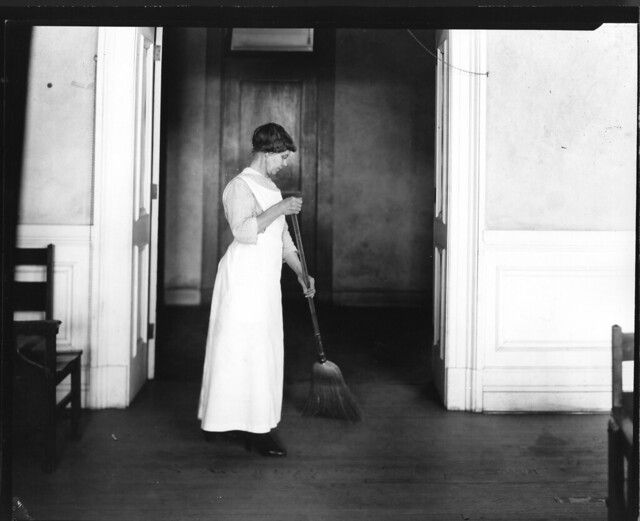 |
| From "Correct Postures for Housework" |
Thursday, July 5, 2012
Copyright in Glass Negatives
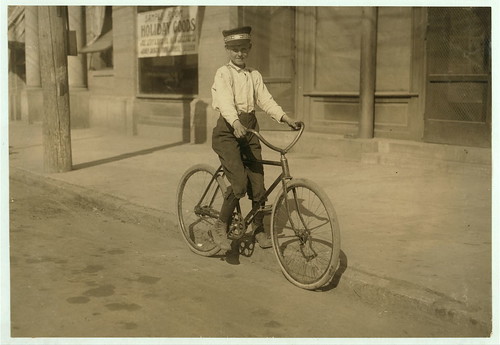
Publication. If the photos were published, the rules vary depending on the date of publication and whether the work had to be renewed. You can explore all of these possibilities using this public domain chart.
Exploiting the negatives. We hope you can share and enjoy the negatives in some way. It's true that a few glass negative discoveries bring about a jackpot, but, alas, most glass negatives aren't worth dragging to Antiques Road Show (although they may have some historical value).
Tuesday, July 3, 2012
Using Willie Nelson Statue on T-shirt

- The Dragon. You should presume that the Schleich dragon is protected under copyright law. Your "irreverent psychedelic pop technique" may create a distinct derivative work, and maybe you could make a fair use argument (see above) but if Schleich saw your work and chose to hassle you, they could drag you into court and make you prove your fair use claim. (It's true that in one case, an artist was permitted to use Barbie dolls in his works but even if your facts are the same, keep in mind that the artist was dragged through a lengthy and expensive court proceeding.) Anyway, with so many public domain dragons, you may want to choose one of those instead?
- George. A portrait of George Washington made during his life time -- for example, one of the George Stuart portraits -- is in the public domain. A portrait first published in the U.S. before 1923 is in the public domain. Works published after 1922 may or may not be in the public domain (check this chart for more details).
- Willie. The Willie Nelson statue is protected under copyright law. It doesn't matter whether the statue is viewable in public or private. We assume the sculptors own the rights (unless they transferred them to someone else) and if the copyright owners find out about your use (and care), they could hassle you. Again, a fair use argument is possible but see above.

Monday, July 2, 2012
Should I Use DRM on My eBooks?

Thursday, June 28, 2012
Is German Autobiography in Public Domain?
 |
| Hermann Stehr |
Dear Rich: I'm trying to ascertain the US copyright status of Hermann Stehr's autobiography Mein Leben. It was published in Germany in 1934 with a copyright notice, but as far as I can tell never published or renewed in the US. The author died in 1940 and so is now out of copyright in Germany, but was not out of copyright in Germany in 1996. Based on this information, would it still be under copyright in the US? Mein Leben is not in the public domain in the U.S. We initially posted incorrect information (and we were fortunate to have Peter Hirtle review it and explain our error). According to Peter:
"The work would have entered the public domain 28 years after publication because of failure to renew that copyright in the U.S. Its copyright would have been restored under 104A on 1 Jan. 1996. On that date, it received "the remainder of the term of copyright that the work would have otherwise been granted in the United States if the work never entered the public domain in the United States." That was 75 years (since extended to 95 years). See my chart on the public domain in the U.S. Assuming that copyright in the work was never administered by the Alien Property Custodian and its restored copyright would not be owned by a government, this work is still protected by copyright in the U.S."
Monday, June 25, 2012
Can I File for PPA in Foreign Language?
We already answered this question once but we loved our infographic (and the information is still current) so we brought it back for an encore.
Friday, June 22, 2012
Wants to Use a 'Maker' Mark

Research, research, research. Dozens of companies use "Maker" as their mark (and let's not forget "Maker's Mark"). What matters is whether your name is likely to confuse consumers of the 3D printing company ( or any other similar-named company within your industry). So, you will need to familiarize yourself with standards of "likelihood of confusion." Then, you need to do a trademark search. Fortunately, we're here to help with a handy video explanation of how to do that. (By the way, besides searching the U.S. Patent and Trademark Office (USPTO), you can also search at Trademarkia.) When searching, search within in connection with your goods or services using the single term "maker," and then again using the compound of "maker" plus whatever second term you are planning on using preceding or following "maker."
Feel good? Register. If you feel confident about moving ahead, you may want to federally register the trademark as that creates a presumptive right to your use. You can learn registrations basics and also how to deal with any objections after you submit your application to the USPTO.
Wednesday, June 20, 2012
Company Wonders About Indemnity Clause

Indemnification. The Client agrees to indemnify, save and hold Planner harmless from any and all liabilities, claims, injuries, accidents, or actions of any kind whatsoever resulting from or arising out of performance of this agreement, whether by rendering services and/or rentals of props and other products, services and equipment. The Client further agrees to indemnify, save and hold Planner harmless against any arrearage or deficiency resulting from misrepresentation, breach of warranty, or from non-fulfillment of any agreement on the part of the Client under this contract, including but not limited to all actions, reasonable attorney’s fees, proceedings, demands, assessments, judgments, reasonable costs and expenses incident to the foregoing.We don't know if it's "standard" for event planners but it's a typical scorched-earth overkill indemnity provision that's intended to relieve the planner of any liability.
What is indemnity? Indemnity is a powerful shield that is typically invoked to get one party to defend the other against third-party claims. For example, if someone (a third party) is injured at the event and that person sued the event planner, you would have to defend the lawsuit. That's not an extraordinary request by the event planner, but this provision goes further. By not limiting indemnity to third-party claims it illogically implies that you would have to pay for a lawsuit brought by the planner, even if it is brought against you and based on his negligence. Plus, the first sentence follows a kitchen sink approach and seems to require that you pull out your checkbook for any possible contingency ("actions of any kind whatsoever"). Ideally, you should only have to indemnify for actual legal claims filed against the planner.
In an ideal world ... If the provision were revised to consider these issues, it might look like this
Indemnification. The Client agrees to indemnify, save and hold Planner harmless from any and all third-party claims resulting from any Client misrepresentations, or breaches of Client warranty, or from non-fulfillment of this agreement on the part of the Client, including but not limited to reasonable attorney’s fees and reasonable costs.Should it be mutual? Indemnity isn't always a two-way street and these clauses are often one-sided—that is, one party provides the indemnity and the other stands to receive it. But they can be mutual and an attorney looking out for your interests might seek an indemnity provision protecting your company against third-party claims arising out of the planner's negligence, misrepresentations or failure to properly perform his job.
Monday, June 18, 2012
IP Resources - Sunnyvale Talk

utility patents - Patents & Business, Nolo's Patent Law
trade secrets - NDAs for Free
design patents - My Design Patent
copyright - Stanford Copyright and Fair Use, Nolo's Copyright Law
trademark - Nolo's Trademark Law, Nolo Trademark Search, Nolo's Guide to Trademark Registration
provisional patent applications - Nolo's Guide to Provisional Patent Applications
Does Site Owner Own Blog Post?

Author/Owner issues. In your question, the blogger is not an employee. Typically, the only way that a non-employee gives up ownership to blog material is by a written transfer (typically an assignment or a work made for hire agreement). But in your question, the blogger is a part-time owner. That raises a different set of issues. What type of business form is it -- partnership, LLC or corporation? If it is a corporation or LLC and the blogger is an officer, the blogger/owner may have written or fiduciary obligations. Alternatively, the corporation's or LLC's owners may have obligations not to compete -- something that might occur if the material was used for other purposes. If it is a partnership (the default for a group of owners who don't do anything formal), is the blog-writing considered part of the blogger/partner's contribution? That may affect claims to ownership. Finally, if the blog is derived from existing company-generated material or research there may be co-authorship or co-ownership issues. That doesn't mean the blogger can't republish it ... but the blogger would have to account to the co-authors if any money was earned.
Friday, June 15, 2012
Dear Rich Staff Live in Sunnyvale 6/18
just when you thought it was safe to watch a Powerpoint ....
Monday, we're live in Sunnyvale to discuss Five Ways You Can Protect Your Great Idea Without Filing a Utility Patent.
Who gets copyright in book publishing contract?
 |
| out of print -- The Book Of Wonders (late 14th Century) |
There may be some administrative advantages for the publisher to acquire protection in its name (and it used to make it easier to proceed against infringers) but what probably matters more than the name of the copyright holder, is whether rights will revert under the publishing contract and what triggers reversion. In today's digital publishing universe, the issue often comes down to when a book is considered to be out of print -- many authors are arguing for a standard based on a limited number of sales per quarter. Here's a related blog entry on the subject.
Tuesday, June 12, 2012
How Do You Opt Out of Craigslist Terms of Use?

Constantly changing EULA. As for your comment about the end user license agreement (EULA) that's constantly changing, we assume you know that's par for the course on the Internet where most EULAs reserve the right for the website to change terms arbitrarily. Look for a statement such as "Company reserves the right to modify and/or change any of the terms and conditions of this EULA at any time and without prior notice." The simplest solution to avoid having these newer user terms enforced against you is to stop using the site for all purposes.
Monday, June 11, 2012
Wants to Fictionalize Baseball Blogs
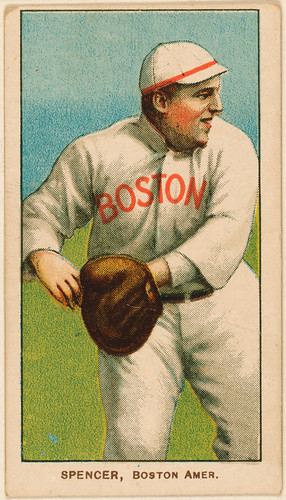 Dear Rich: I am in the process of writing a fictional novel. Part of the novel involves a romance with a minor league baseball player. Since I know nothing about life in the minor leagues, I've been reading baseball wives blogs. I was hoping to base some of my material on the material written in these blogs. Is this a case where I would need a life rights agreement from the writer of these blogs, or is it considered public domain now that it is written on the Internet? Most of the material from the different blogs is similar in content, and since the story is fictionalized, I think they would have a hard time relating the incidents in the novel to their own blogs. Again, I wouldn't take any specific information, just base my fiction off of their real-life incidences, and for only a portion of the novel. What do you think? We were going to say, "No worries," but we couldn't do it. We think 'No worries,' like it's cousin, 'No problem,' is just another responsibility-shifting language gambit. For example, when we announced that the coffee pot was empty at our local cafe, we were told "no worries," as if we shouldn't feel bad (or we should) for "worrying" about the lack of caffeine. A more traditional response would have been, "Okay, I'll bring you a fresh pot," (or the employee could have said nothing -- grumpy employees are fine with us). We believe 'No worries' is a subvariant of 'whatever' and that its Australian-U.S. transmutation is a result of a misreading of Meher Baba (who did incorporate responsibility).
Right, you had a question. It's fairly common for novelists to do what you're doing -- fictionalize anecdotal material from true life stories. The case law on the subject leans heavily towards permitting fiction writers to use facts and stories from real life. Generally, there are two things to keep in mind if you want to be free of hassles.
Avoid using material in a manner in which a specific person can be identified from the retelling. Changing settings, names, dates, etc. can all prevent someone from making a claim that readers identify the characters with specific individuals which could in turn give rise to claims of defamation (if the story weren't true) or invasion of privacy. For example, you are certainly free to create an evil antagonist in your novel who is an ex-hall of famer, owes money to the IRS and is trying to buy a baseball team. But you shouldn't set the story in San Diego, name the character Gwynn or Tony (or something similar) and have him team up with a movie producer. This article explains how to put distance between your fictional character and a real life counterpart.
Rewrite the adventures so that that you only borrow the underlying facts. Avoid claims of copyright infringement by not lifting the language or unique expression provided by the blogger (not merely the anecdotal material or underlying facts). Check out this article for more on copyright, novels and facts.
Animated Gif Dept. Thanks to our readers for finally telling us to turn off the flashing GIFs (sorry, but we need to keep the CLA banner ad on for a few more weeks). Who knew there were government guidelines?
.
Wednesday, June 6, 2012
How to Find Quotes to Use on Greeting Cards
 Dear Rich: I have created a card line from my art. I want to use inspirational quotes. I was able to contact Mary Oliver's staff and they said no. Anais Nin's estate want money to use them. Other than those two I am having a hard time determining. Rumi? Rilke? Movie quotes? Music quotes? Others I haven't heard of before but have lovely things to say. Can you help me sort it out? First, the animated GIF issue. As regular readers may have noticed, we've settled down quite a bit and we seem to be finding our pace. Thanks for your helpful comments and feedback.
Right, you had a question. Attempting to negotiate permission from famous poets or songwriters (or their estates) can be expensive, frustrating and time-consuming. If we may recommend an alternative, legal course to pursue -- find similar writers whose works are in the public domain. One way to find out what potential consumers might like is to use Google's new Knowledge Graph feature. If you type Mary Oliver into Google, for example, a box appears on the right of the listings (see above) showing you what Oliver-searchers are also searching for (surprise - Jalal ad-Din Muhammad 'Rumi' is No. 1). How do you know which writers are in the public domain? This article provides the basics and if you need more help, consult Steve Fishman's helpful book.
Subscribe to:
Posts (Atom)