Showing posts with label contracts. Show all posts

Wednesday, March 1, 2017

How Long Does My Permission Agreement Last?

Dear Rich: During my graduate research in the mid 1990's. I interviewed individuals that were appropriate and that agreed to participate in my study. I have signed and dated permissions forms that explicitly inform the participant that their recorded interview could end up in a published journal or book. Is there an expiration date on the permission they granted? 
Unless your agreement provides an expiration date ("This agreement terminates on March 2, 2017"), the permission is still valid for the purposes stated. Contract provisions may also provide a right to terminate at will or under certain circumstances (often, a set amount of notice is required)
Other reasons your agreement may have terminated. Our contracts book explains other reasons that agreements terminate:

  •  Both parties have fully performed. Many contracts, particularly oral agreements, end when everybody’s done what they’re supposed to do. For example, you paid for the vintage pink mohair sweater at Etsy and the seller has delivered it. 
  • One party has committed a material breach. If one party breaches, the other party can say, “That’s it, we’re done,” and terminate. 
  • Court-ordered termination. Courts have the right to terminate an agreement if there was a breach, the contract was void, or the contract violates the law or public policy.
  • Mutual termination. The parties to a contract are always free to mutually terminate a contract.
If none of these apply to you, your agreement is still enforceable. For more on drafting permissions, check out Getting Permission.

Thursday, August 6, 2015

What's the Down Side To Using a Stage Name for Business?

Dear Rich: I am in the process of making marketing videos on youtube, webinars, public speaking seminars and authoring informational books. For privacy reasons and because of my unusual and hard to spell name, I would like to use a first and last name that is different than mine in these situations. I do not plan on changing my name legally, like on my drivers license, but to feature it in these works that I publish myself. Is there any issues from a legal standpoint, that is, not holding myself properly to my clients/ customers. The main jurisdiction that I plan on doing business is Canada and the USA if that helps.
We can't comment on Canadian law but in the U.S., probably the only issues you will face are getting paid, entering into contracts, and registering copyrights. Because you are doing business under another name (DBA), you should indicate that fact when entering into agreements -- for example, "Robert Smith DBA Harry the Heretic." Ditto for filling out W-9s and W-4s for hiring parties -- use your real name for tax purposes. If you're publishing copyrightable materials under a pseudonym, you have the option to indicate that when preparing your copyright application. As for getting paid, try to set up direct deposits. Otherwise, you'll want your real name on any checks to avoid bank teller hassles (i.e., "Excuse me while I get my manager!").
P.S. Have you checked to make sure your pseudonym is not already in use for similar goods and services?

Friday, October 31, 2014

Contract Survivalists: When Is the Contract Over?

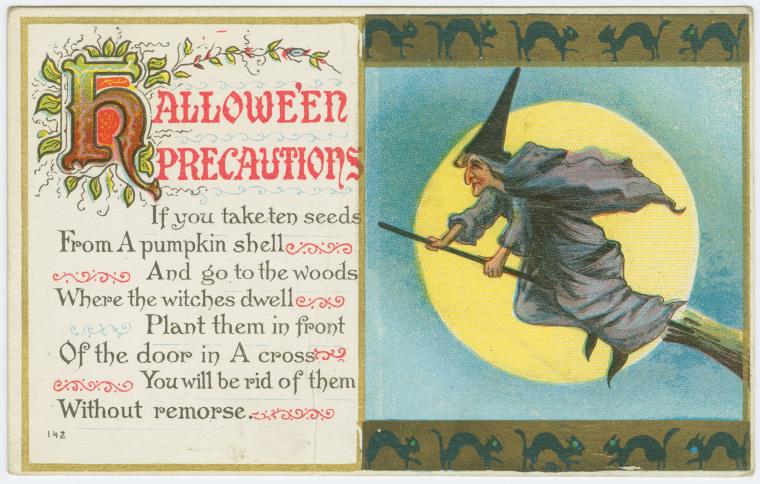
Here's a tip to survive Halloween. Check out more PD Halloween postcards.
Dear Rich: We were asked to sign a work for hire agreement to modify a website. The contract was for a year, but there was language in it that seemed to contradict the one-year thing. The language said that three provisions in the agreement survived termination and could be enforced after the contract was over. This doesn't make sense. If the contract is over, how can the company still have any rights over me? Right, you would think that once the contract is done, it's done! But just because an agreement terminates doesn’t mean that all of the obligations in the agreement terminate. For example, the parties may want to continue their obligations to maintain confidential information after the agreement ends. Or, additional payments may accrue after termination. To handle situations like this, the parties often state that certain obligations will continue or survive the termination of the agreement. Typically, those provisions include confidentiality, warranties, indemnity, and payment obligations. You can spot them because they usually start with, “This obligation shall survive any termination of this agreement.”
Are they really enforceable? Courts may not always enforce survival clauses. In general courts prefer fixed (not open-ended) periods of survival as well as a clear indication that any claims regarding the provision will be brought prior to the end of the surviving clause.


Friday, November 15, 2013

Famous Person Won't Pay for Web Work

Dear Rich: I designed a blog for a certain very famous person several years ago, and everyone was happy. This past summer, I outlined a list of updates that I would suggest making, and they agreed that those were all a good idea, so I wrote up an estimate and started work. Work was submitted for review by them in July. The review took forever, I issued an invoice at the end of August (I hadn't heard anything and didn't want to wait), the famous person got grumpy, didn't pay the invoice for 2 months, then sent me 40% last week with an email saying it took too long to complete and they wouldn't pay the balance until sometime in December. I gave them notice that this wasn't acceptable, and, when I didn't hear back from them within 24 hours, I suspended their access to the backend of their website. The site remained live and active, and nobody but them would know what was going on. This is a pretty standard practice in this industry, much like when one doesn't pay one's electric bill, and it successfully got their attention, for better and worse. They decided they no longer want to work with me (no problem here!), and asked me to surrender access to all domain hosts and registrars etc, as well as sign a confidential settlement agreement. I've given them access to all sites and registrations and everything that they can legally consider theirs. I've even agreed to let them continue using my creative work (the theme that the blog uses) as long as I get paid for it and can take credit for my work. 2 pretty basic things. The problem is the settlement agreement. This is what I do for a living, and I don't want to remove the site from my portfolio, but they want that to be a term of the settlement agreement. They insist that I not link to the site or use the famous person's name. I pushed back and added a clause declaring the design and programming to be mine, and they have yet to get back to me about that. Because I've given them access to everything they need to transfer the website, they have begun transferring everything over to a new server, including my intellectual property, and I'm pretty sure that they won't negotiate on the settlement agreement until they've completely removed the site from my servers.We're about to enter a situation where I have no leverage, and they won't agree to pay me unless I sign a contract agreeing to their terms.  Should I take measures to stop them from transferring the part of the site that is my intellectual property? Should I issue a cease-and-desist since they're currently using my intellectual property without my permission? The only two things I care about are getting paid for work done months ago and being able to take credit for my work. We think you're likely to be outgunned in a legal battle. Here's why:
  • Unless you had a contractual right to do it, turning off "under-the-hood" access could work against you.
  • If you started the work without approval, that may relieve or reduce the famous person's obligations.
  • As for your contribution to the look and feel of the site -- "the theme" -- you could have a hard time claiming proprietary rights
  • Alternatively a court may determine that you granted the famous person a nonexclusive implied license to use your theme. 
  • Even if you prevail, the costs will easily exceed any potential payout (unless you have an attorney fees provision). 
So what about settling? You want credit and payment. Famous people are picky about who can use their name for promotional purposes so you need a workaround for the credit and portfolio rights. Perhaps there is some special language you can agree upon that will satisfy all the parties -- for example a statement in your portfolio that the reference is not intended to imply famous person's endorsement. (In the future, try to negotiate credit before you start work.) If you use any backend software programming and coding tricks -- the things that you developed and routinely use to make your job easier -- then retain rights to continue using those.  Have an attorney review the settlement. Try to get payment in full at the time of signing. You want to walk out with the money.

Friday, June 28, 2013

More on Parental Consent for Contracts

Dear Rich: In yesterday's blog, you mentioned that a parent's consent should be obtained when contracting with minors. What's the effect of a parent signing the agreement with the statement that you note? Do you think the parent's signature cuts off the minor's right to void the license agreement while still a minor? As a general rule, a minor can void an agreement signed while under the age of consent (18 in most states) prior to reaching the age of consent. If a parent or guardian co-signs an agreement with a minor, the parent is obligated to fulfill the contractual obligation (if possible) or compensate for the damages caused by the termination of the contract. For that reason, assignments by a minor typically include parental consents such as this one for magazine submissions, or this one used for student entries in a contest. We caveat this by saying we have not found any cases where a minor sought to void a copyright assignment or copyright license that was co-signed by a parent or guardian ... so we can't guarantee that a parental consent on a license will be enforced. However, by analogy, patent law does not require consent by a minor's legal representative for oaths or declarations.
Contracts that can't be voided. In some states -- for example, California and New York, certain contracts with minors (and with a parental consent) can be approved by a court thereby making it relatively bullet proof from attack by a minor. And although we didn't get into the details in our previous post, certain contracts -- whether or not a parent co-signs -- cannot be disaffirmed by a minor if they are for payment of taxes, banking agreements, military obligations, or necessities. (Also parental consents releasing a minor from injuries -- for example, a release at a ski resort -- may not always be binding on a minor.)

Monday, April 29, 2013

Can We Get Out of Record Deal?

Dear Rich: I am in a band and last year we signed a distribution and publishing agreement which has turned into an absolute mess. I used to sing in the band but subsequently have found myself less our singer and more our copyright lawyer. I am better at singing. Our agreement made us solely responsible for paying for and producing the master recordings - we did. The label's responsibility was in providing marketing, booking, and distribution - they didn't. As a result we told them they were in breach of contract and gave them a 60 day notice letter wherein they had 60 days to remedy their non-performance or be in breach and the contract would be terminated. The confusing part is that they then proceeded to put our recording up for sale through physical and digital means. We told them to stop selling based on the fact that no separate "Exclusive Co-Publishing Agreement" was ever reached. Below is an excerpt from our agreement outlining the publishing deal (names changed, Sub=band, Company=label): 
 You hereby agree to grant and assign to Company affiliated publishing company, Mr Publisher (ASCAP) a division of Mr Publisher Media Group LLC a 50% copyright and performing rights interest less collection fees and 100% administration rights in and to each musical composition written, owned or acquired by you during the term of this recording agreement ("Compositions"). In connection therewith, you agree to enter into a separate Exclusive Co-Publishing Agreement with Mr Publisher (ASCAP), the terms of which shall be negotiated in good faith, but which shall include the right of Mr Publisher (ASCAP) to administer the Compositions throughout the world and may elect to charge an administration fee of (ten 10%). Should Company and Sub decide to terminate this agreement all rights of copyright will revert back to Sub unless Company can prove substantial progress in its tenure of administering compositions. 
Since we are splitting the copyright does that mean they are able to continue selling our music without our permission? Are we able to register our masters with the copyright office on our own given they have a 50% stake? So confused... Whenever the Dear Rich Staff gets a long letter that includes excerpts from a contract, our first thought is usually, "Get thee to an attorney." We think that's the proper course of action in this case. Here's why:
The cure letter. If your basis for claiming breach of contract was a failure to market, book and distribute the band, then by providing the "cure" letter you gave the company 60 days to correct those omissions. If the label failed to market, book and distribute within 60 days of your letter, the agreement is terminated. Putting the music up for digital and physical sale isn't enough to cure. The label needs to demonstrate an effort to market and book the band, too (and correct any other omissions mentioned in your cure letter). If not cured, the label is in breach and your grant (assignment) of publishing rights would be terminated as well. In other words, terminating the record deal for breach would allow you to retain all of your publishing rights and there would be no reason to execute a written publishing agreement.
Get out of it! So, you should stay focused on ending the contract  which, by the way, seems a bit lopsided (welcome to the music business). As we understand it, you pay to produce the album and you give up half of your publishing. The label doesn't seem to be taking any risk. After all posting a recording is easy, and creating physical CDs can be done without much of a financial commitment. So, unless the label has an impressive track record with other artists, you'd do best to pool your money, hire a lawyer and make sure the agreement is fully terminated quickly. The annoyingly difficult part is getting the label to take down the music it has posted for sale. In conjunction with getting an attorney, you should also register your music at the Copyright Office and with a performing rights society. And of course, another reason to check with an attorney is that we could be completely wrong about all of this. A second opinion will help.
Hiring a lawyer. If paying for a lawyer is a challenge, find out if there's a volunteer lawyer for the arts service near you.


Friday, April 26, 2013

Illustrating Book About Chinese Zodiacs

Dear Rich: I'm an artist and my friend is a writer. She wants me to illustrate her book on Chinese zodiac astrology. My art would be heavily displayed in the book. How do we work out my getting paid for my art? Do I charge her a flat fee or take a cut of the earnings? Consider the following questions before proposing anything to the writer.
Is the artwork supplementary or essential? If the artwork is an essential part of the purchasing decision -- as in a home decorating or children's picture book -- that would be more likely to justify a cut of the earnings. If the illustrations simply supplement the writing (as in most nonfiction books), flat fees are more common.
How much time will it take and what is your time worth? Estimate the number of hours per drawing. If you were billing an anonymous client for the same work, what would you charge? This would be your starting point in determining what you want to earn back (though of course there may a steep discount for your friend). The Graphic Artists Guild Handbook provides assistance with pricing.
How likely is it that the book will be distributed by a commercial publisher? If this work will be the subject of a book deal, the typical advance (assuming there is one) for a nonfiction book would be between $3,000 and $10,000 (though others indicate these advances are higher; we don't think that's an accurate reflection of today's marketplace). Royalties would be 5 to 10% of the book's income but would only be paid after the advance has been earned back. Nonfiction books usually have a sales life of 12 to 14 months. If a book deal is in the works, and you feel you are entitled to a cut of the earnings, you should seek to become a party to the publishing contract. Otherwise, you must rely on the writer to receive the income and then forward your payment.
What does your friend want to do? Because you're dealing with a friend -- not an anonymous client -- we'd like to see you work out an arrangement that doesn't jeopardize your personal relationship. You could propose a two-tiered system -- for example a reduced flat fee but an additional payment if a book deal is signed.
What about the rights? Are you transferring copyright ownership? Do you want to retain certain rights so that you can continue to use, sell or display the artwork. Determining rights may affect the price. For example, if you would like the right to sell limited edition prints, or to advertise those prints in the book, you might want to adjust your fees accordingly.

Wednesday, January 16, 2013

Can Band Leader Sign Contract for Band?

Dear Rich: Our band is built around a charismatic lead performer, kind of like Bruce Springsteen and the E Street Band. The band got asked to sign an agreement with an indy label. Except when it came time to sign, only the leader of the band signed, not the rest of us. Does that mean that only he is bound by the agreement? Does this mean that only the leader gets money from sales of recordings? The band members are probably not bound by the agreement (and therefore not entitled to income from it). Most labels that want to bind musicians make them sign the paperwork. However, the answer really depends on (1) how your band is structured -- that is, what type of entity you are (2) in what capacity the leader signed the agreement, and (3) what the agreement stated -- specifically are the band members named as "parties" to the agreement.
Leader as sole proprietor. If the leader hires the band members and pays them as contractors --- for example, contracting for performances -- then he is a sole proprietor and the band members are considered independent contractors. In that case, you would not be bound by the agreement unless you signed it, as well.
Partnership? If the band is a general partnership (the parties share in the liabilities and profits), band members may be bound by the signature. (You do not have to have a formal partnership agreement to be a partnership.) Typically, you're a partnership if you all contribute to the business (equipment, time and money) and share income (performance, royalties, etc.) In that case, any general partner can bind the band. So, if the leader signed the agreement on behalf of the band then the band could be bound. (Here's an article about contract signatures.) If you have a copy of the agreement, check to see whether the partnership is named as a party to the agreement, in which case all of the partners are bound "individually and collectively".
Corporation or LLC. If the band has incorporated or formed an LLC, the leader could also bind the band if corporate or LLC documents authorized the leader to sign on the band's behalf.

Monday, July 9, 2012

Working With Developmental Editor

Dear Rich: I am developing a book and I'm considering working with an editor who will assist with development. The editor sent me a confidentiality agreement to sign basically protecting her company in the first part and protecting me and my book idea at the end with these two paragraphs. 
The Author’s commitment to maintaining the confidentiality of Company’s Confidential Information shall not extend to information the Author already possessed at the time of disclosure by Company, information which is in or subsequently becomes public domain, whether through release by Company or through a source other than the Author. 
Company understands that the Author will share information about the Author’s work, including, but not limited to, draft manuscripts and/or concepts for a book or books (hereafter “Author’s Confidential Information”) with Company during Author’s dealings with Company. Company agrees to keep Author’s Confidential information confidential, except as necessary to provide services to the Author.
I wanted to know if that’s all I need for an initial meeting with a book development editor. 

We're excited because this is the first time that a reader and the Dear Rich Staff went to the same summer camp -- Camp Lohikan. We have fond memories of our times there but we're glad we got out before the Honda dirt bikes arrived.
Right, you had a question. The first paragraph, above, is a typical "exclusionary" clause from an NDA and we explain its purpose at our NDA site. It's nice to have this clause but its absence probably wouldn't make much difference, as a court would insist on these exclusions even if they weren't part of the contract. The second paragraph establishes that confidential information about your book won't be disclosed unless it's required for the Company to do its job. You might inquire as to what types of services require disclosure. If concerned, you might even insist that the agreement be modified so that your permission is sought whenever the Company discloses the book to a third party. 
Is that all you need for the meeting? You could have an attorney look at the remainder of the contract, or you could review the basics of confidentiality agreements at our site. And of course, if you have sufficient clout in negotiations with the editor, you might want to consider providing your own contract. That agreement could sort out any copyright or ownership issues or prohibit the editor from publishing a work that competes directly with your project.
Who do you trust. Mostly it comes down to trust. The biggest issue for you is whether the editor is reputable and whether you can trust her. Generally, it's difficult for an editor with an unethical reputation of stealing book ideas to stay in business for a long time. So if an editor's been around for many years, that may be an indicator of trustworthiness. Perhaps you can also ask to speak with other clients, as well as checking the editor's reputation online.

Monday, January 16, 2012

Won't Pay for Photos: Can We Demand Takedown?


Dear Rich: I am a professional photographer with question about transfer of copyright. Recently I did a job for a customer. As usual I provided them the images and sent them an invoice. The invoice clearly describes the permitted usage and terms for payment. The customer sent the images to a major retail chain to use on their website, which is apermitted use. Currently they are about 60 days late on payment and will not return e-mails or take my calls. Am I correct to assume that since they have failed to adhere to the terms of payment they do not have the right to allow the retailer to use the images? If so can I request that the retailer remove the images from the website? The amount that they owe me does not warrant legal action. I have the feeling that the only way to encourage them to pay is to inform them that I intend to ask the retailer to remove the images because the vendor has failed to pay for the images. Speaking of professional photographers, can we take a moment to digress about one of our favorite shutterbugs (and full disclosure -  a former client)? He's Bobby Neel Adams and he's great (we've got a print of the photo, above, in our office). It's from a strangely upbeat series of Adams photos of landmine victims called Broken Wings. We could go on and on but just check out his work.
Right, you had a question. You may consider this as bad news, but -- assuming you have entered into an enforceable contract with the customer -- it would be improper for you to ask the retailer to remove the photos. You could only do that if the use was unauthorized. In this case, the use apparently was authorized --  you just haven't been paid for it. If the contract was fraudulently induced and the contract was rescinded (as explained in this case), you could proceed as an infringement action. But it's usually much more difficult to prove fraudulent inducement (the other party never intended to pay you) than to prove contract breach (the other party delayed paying you). Typically, in situations such as yours (and in this case and this case), your remedy is to sue the customer for breach of contract. That may sound wrong to you. After all, if you haven't been paid how can they use your images? So what's a photographer to do?
Some options. The gang over at PhotoAttorney state that it's possible to insert language into a contract that would permit an infringement lawsuit if payment is not received. The language indicates that no rights can be exercised until payment is received and that any such uses will be considered willful infringements. (The crew at ASMP supports a similar position.) We think the provision could be improved by adding a statement to the effect that, "In the event that rights are granted prior to payment to photographer, this contract shall be automatically rescinded."  We can't guarantee the enforceability of the provision (because a court is the ultimate authority on whether a contract is rescinded), but it should come closer to meeting the standards explained in the cases cited above. BTW, you may want to check out our answer to a similar photo question.

Thursday, December 15, 2011

What's the Meaning of "Relationships" Clause in Contract?

Dear Rich: I was reading the basic NDA on your website and I'm unsure of one clause you included. "5. Relationships. Nothing contained in this Agreement shall be deemed to constitute either party a partner, joint venturer or employee of the other party for any purpose." This is a confusing statement. Would you be able to explain what this means? Any help would be appreciated. Thanks! If you were reviewing an NDA at our NDAsforFree.com site, then the explanation should have been available to you by clicking on the hyperlink for "Relationships." If you were unable to access it, here's an explanation below. (Note that this clause is also sometimes referred to as a "No Joint Venture" clause, too.)
Your relationship with the receiving party is usually defined by the agreement that you are signing -- for example an employment, licensing or investment agreement. To an outsider, it may appear that you have a different relationship, such as a partnership or joint venture. It's possible that an unscrupulous business will try to capitalize on this appearance and make a third-party deal. That is, the receiving party may claim to be your partner to obtain a benefit from a distributor or sublicensee. To avoid liability for such a situation, most agreements include a provision like this one, disclaiming any relationship other than that defined in the agreement. We recommend that you include such a provision and take care to tailor it to the agreement. For example, if you are incorporating the NDA provision in an employment agreement, you would delete the reference to employees. If you are using it in a partnership agreement, take out the reference to partners, and so forth.