Showing posts with label first sale. Show all posts

Wednesday, February 1, 2017

Can I Use Sheet Music as Part of Crafts Product?

Dear Rich: I'm about to launch an online marketplace for handmade crafts which includes customizable gifts which incorporate a customer's favorite or most inspirational song printed on aged, antiqued paper decoupaged (collaged) on to a keepsake box. I'm subscribed to a third party service and I pay for each printing of the sheet music I then age and use for the keepsake. The copyright is noted at the bottom of each page, along with an additional notation of my personal payment and my name with the date. I generally don't use the entire song sheet. I also print a second "clean" copy of the sheet music and file it in case there are ever questions about permission. Since I'm not familiar with copyright law, I'm a little nervous that this may be problematic.
The question you're wrestling with -- whether the purchase of a copyrighted item permits you to use the item as part of another product -- has come up several times in court cases. For example, a company purchased notecards and affixed them to tiles and a court ruled that was permissible under the first sale doctrine (a legal principle that guarantees you the right "to sell or otherwise dispose" of copyrighted items). Another court took the same position when a fabric manufacturer complained about the use of its copyrighted fabric in children's bedding.
On the other hand ... A federal court in  California ruled that ripping out images from a book by Patrick Nagel and reselling them on tiles was not permitted. Another California court ruled that pulling art images from a book and framing them was not permitted. And New York court  prohibited a company from re-selling posters after making them appear like oil paintings on canvas. These cases are based on the idea that the resulting products (framed artwork and decorative tiles) are derivative works (new works that transform, adapt, or recast existing works).
Five things to consider: 
  • Did you enter into a license agreement when you downloaded the sheet music? Check to see whether you clicked-to-agree to limited uses of the sheet music. A licensing agreement may trump copyright law.
  • Don't make copies of sheet music. Only affix purchased copies. If the first sale doctrine shields you, it will offer protection only for authorized copies.
  • The likelihood you'll get hassled is proportional to your company's profile. The bigger your company and the more expansive its marketing, the more likely a music publisher may object. The larger your sales, the more incentive there is for a lawsuit. Companies usually go after those with deep pockets especially when the caselaw is as confusing as it is for the first sale doctrine. 
  • If hassled by a cease and desist letter, consult an attorney. You may want to stand your ground, at least at the letter-writing stage. (Keep in mind that scholars and others have disagreed with the reasoning of the California courts.)
  • Don't ask the sheet music company for permission to affix the music to keepsakes. Digital sheet music sellers are distributors with a narrow range of rights. They don't have the power to grant you anything other sheet music. Only the song copyright owner (a music publisher) can grant you the rights.


Tuesday, August 5, 2014

Selling Refurnished Products

Dear Rich: Do I need authorization from the manufactures (such as Apple, Samsung, Sony etc.) to buy and sell their used/refurbished products on-line and in-store in the USA? You can re-sell other manufacturer's products as long as you don't mislead consumers into believing that you are an authorized dealer or agent of the manufacturer. You also shouldn't mess with the manufacturer's logo, lift advertising copy or images from the manufacturer's site,  or replace the manufacturer's authorized parts with third-party parts. (As happened with Rolex watches.) Your right to resell is based on the first-sale doctrine (or trademark exhaustion).

Tuesday, March 25, 2014

Wants to Sell Kiosk Using Apple Computer

Dear Rich: Hi, I'm building a kiosk system that runs on an Apple computer. The main component in the kiosk system, at least as we intend it to be, is the software. We would simply like to use an Apple computer to run the software on. The computer will most-likely be housed inside the kiosk enclosure and not visible to the user. Would it be legal to sell such a system?Yes, assuming you've legitimately purchased the underlying systems, you can resell them under both patent law (under a principle known as patent exhaustion) and copyright law (under the first sale doctrine):
  • Patent exhaustion. Once a patent owner sells a product, the patent owner cannot seek further patent payments for that particular product.
  • First sale. You can also resell copies of works protected under copyright law. However, this rule may be "over-ridden" in some states where courts have held that software isn't sold; it's licensed and can only be 'resold' under the terms of an end-user license agreement.
Trademark law should not be an issue as long as you don't imply that Apple is affiliated with, supports, or endorses your endeavor.

Thursday, October 4, 2012

Cornhole Board Kits and Sports Teams

Dear Rich: I just stumbled upon your blog post regarding cornhole boards and sports decals. I am a maker of custom boards and I'd like to sell boards in team colors. I know that I can't attach logo decals to the boards. However, am I within the bounds of the first sale doctrine if I sell boards in team colors and include licensed logo decals that are not attached to the boards? I believe that I should be okay if the purchaser needs to attach to decals, correct? Uh, we're not so sure. As we indicated in the previous post, buying and selling team decals is fine under the first sale doctrine. But selling a "kit" with a decal and team-colored board may not provide a successful infringement end run.
When the first sale fails ... The first sale doctrine cannot be used as a defense when non purchasers of the item (people who see the assembled product but who didn't purchase the kit) would be confused as to the source. This case provides some background on the principle and illustrates a few cases where the first sale defense failed. (Here's an article explaining the case.) By analogy there is a Supreme Court patent case that prohibits the "knowing" sale of kits (by which the purchaser can assemble an infringing invention). In that situation, the seller can be charged with inducing infringement. Bottom Line Dept. We can't predict how a court would rule in your situation but we believe that if the leagues learned of your activity, they would seek to halt it based on a theory of inducement of infringement.

Wednesday, July 11, 2012

Wants to Use Victorian Paper Scraps

Dear Rich: I am a fashion designer with a small clothing label. I'm interested in using some 'victorian paper scraps' (they are printed onto the fabric) and then I plan in my turn to stitch them on some garments in my clothing collection. They will be sold commercially and as I don't want to step on any ones toes nor break any copyright laws or infringe in trademarks. I have asked the seller if the prints are over a 100 years old and I can use them commercially and she says they are? Is there any way that I can find out to be certain and what would you advice me to do. I just want some piece of mind when using them, knowing that I won't get into any trouble. The short answer to your question is that your activities -- cutting up and restitching of existing fabric -- won't violate any laws. Your activities are protected under a principle known as the first sale doctrine. You would only run into a problem if the images were protected under copyright (which we seriously doubt) and you were duplicating those images (that is, making copies). BTW, we talked about the first sale doctrine in a previous post.
Why don't we believe these scraps are protected by copyright?  According to this site, Victorian paper scraps appeared at the beginning of the 19th Century initially in black and white or color (if hand-tinted). Color printing of these scraps began in the late 1930's. Because of these dates, chances are very strong that these works are in the public domain (see this chart for more details) either because copyright expired or was never renewed. In any case, determining whether copyright exists is an academic exercise as your use is permitted by the first sale doctrine and does not violate copyright law.

Wednesday, April 11, 2012

Wants to Use Images from Adult Coloring Books

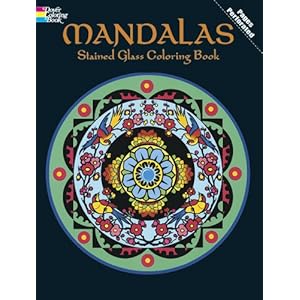
Dear Rich: I enjoy coloring and crafts. I purchase adult coloring books by Dover Publications thru Amazon. The pictures I color are called mandalas. I color, decorate and frame the pictures. If I were to sell these at a craft fair would I be in violation of the copyrights? I am a 65 year old widow looking for extra income but I do not want to do anything illegal. I am only coloring pictures I purchased and am not putting my name on it. It is for decoration only. Please let me know. We're so ashamed of ourselves. When you used the term "adult coloring book," our minds foolishly lept to X-rated coloring books. Little did we know that the terminology is commonly used to distinguish a genre of non-kids coloring books. Please forgive us.
Right, you had a question. Yes, we believe that coloring in, tearing out, and then selling pages from Dover Publications is permissible for a few reasons. Without first considering copyright law, we can't imagine that Dover --  a company with a lot of goodwill amongst crafts artists -- would pursue legal claims against an 60+ artist selling single images from their mandala books at a crafts fair. (They'd be headed for a variation of the Streisand Effect!) In any case, you could probably make a decent claim under copyright law that your use is justified by the first sale doctrine. (Note that the first sale doctrine can be a complicated pointy-headed kind of issue, as we discussed in a previous post.)
Dover's Policy. In any case, we looked at Dover's policy as expressed in one of their Mandala books. Reproductions by a graphics service (you're not doing that) are prohibited. The policy also states:
"You may use the designs and illustrations for graphics and crafts applications, free and without special permission provided that you include no more than four in the same publication or project."
We're not sure that applies to what you're doing -- you're not assembling a publication or project -- but we think it indicates a level of tolerance for crafts people with similar projects. We think as long as you avoid selling reproductions of your images, and as long as you avoid using coloring books that specifically prohibit what you're doing, you should have a green light for your plan.

Tuesday, November 15, 2011

Can We Upcycle Band T-Shirts?

Dear Rich: In an online selling venue, we have a thread going with a discussion about upcycling a t-shirt with touring band theme designs on them. One person wants to use these copyrighted shirts to "upcycle" them into another piece of clothing or a hand bag, that they would then offer for sale. Some of us say "no" because it's still a copyrighted image on the shirt. You bought the shirt, not the image. They say since they own the shirt, they can do anything that they want with it. They say that the shirt maker bought the right to use the image, therefore, the copyright owner has already been paid. We had to look up the definition of upcycling and as far as we can tell, it's recycling but with a bigger profit margin. Like, lately we've been capturing the cold water in our shower as the water warms up. If we just dump that water on to our plants, we're recycling, but if we flavored that water, froze it, and sold it as Fair Trade Popsicles, we would be upcycling. (We think lime flavored would be best as it would have a green color.)
Right, you had a question. You should be able to re-use band touring t-shirts in clothing or in a handbag without asking for permission. Copyright law permits the purchaser of a copyrighted work to resell, destroy, or do whatever they want to that work, as long as they don't step on any of the copyright owner's exclusive rights. This principle is known as the first sale doctrine, and that's why people can sell used books, movies, and music on eBay and Amazon. The term "first sale doctrine" comes from the fact that the copyright owner maintains control over a specific copy only until it is first sold. (One exception: If it's a limited edition artwork or fine art work -- for example, signed and numbered photographs created in limited editions of 200 or fewer copies -- you can't destroy it.)
But it's not so simple. The rules are a little different once you start to disassemble or reconstruct the copyrighted object. In one case, for example, it was okay for a company to make baby bedding from a copyright and trademark protected fabric. But there is a conflicting line of cases that makes things a little confusing. In one case, a company purchased a book of prints by the painter Patrick Nagel and cut out the individual images in the book and mounted them in frames for resale. A court of appeals in California held that this practice was an infringement and was not permitted under the first sale doctrine. (Mirage Editions, Inc. v. Albuquerque A.R.T. Co., 856 F.2d 1341 (1988).) (A similar result was reached in Greenwich Workshop Inc. v. Timber Creations, Inc., 932 F.Supp. 1210 (C.D. Cal. 1996).) In a different case, a company purchased note cards, mounted them on tiles, and resold them. A federal court in Illinois determined that this practice was okay. (Lee v. Deck the Walls, Inc., 925 F. Supp. 576 (N.D. Ill. 1996.) (The same result occurred in C.M. Paula Co. v. Logan, 355 F. Supp. 189 (D.C. Texas 1973).) So, under these rulings, a person cannot rip individual images from an art book and resell them in California, but a person can mount individual note cards and resell those in Illinois and Texas. We don't think these rules will affect your activities unless you were to cut up a shirt and take two or more separate images and repurpose them on multiple products. But reusing a single shirt to create a single item of clothing or a handbag should be fine.
Beyond copyright. There are some other rules for repurposed items that contain trademarks or infringe on a band's right of publicity. Most likely these won't be an issue but to be on the safe side, you can avoid any impression that the touring band endorses the shirt by advertising the items as Handbags Made from Upcycled Rolling Stones T-Shirts instead of saying  Rolling Stones Handbags.

Wednesday, October 26, 2011

Using Text of Operas ... in Paintings

Dear Rich (and Dear Rich Staff): I have created painted works of art with oil on canvas and water color marker on paper using the text of public domain operas and plays in such a way that they are no longer readable as text. The full text is still there but, it has been over written in a variety of colors such that one could not actually gain any context or meaning from trying to read the painting as a copy of the opera or play. I judge that this as fair use and should be able to sell my work without consequence. Do I need to get permission to use copyrighted work that has been similarly obscured for this purpose if I intend to sell the unique painting I have created? Just an FYI, but you state you're using the text of public domain operas. If the text of the opera is in the public domain, there's no need for a fair use argument -- you can do whatever you want with it. As for your question about the use of copyrighted works there are two ways that could play:
  • If you purchased the text of the opera -- for example, in sheet music form or in a book -- and you are painting on the pages of text (or incorporating them a collage), you won't need permission. You can probably justify that under the first sale doctrine
  • If you are reproducing the text in a painting, we think you can probably make a strong fair use argument because you are using a small portion of the opera's text, you are not competing with or depriving the copyright owners of commercial gain, and based on your description, your use appears to be transformative --  that is you're making a new statement. if the words are obscured so that their meaning cannot be ascertained, we're not even sure you've infringed as your artwork no longer would be substantially similar to the opera text. Check out fair use rules before proceeding.