Showing posts with label registration. Show all posts

Tuesday, January 24, 2023

Does Renewal Apply to Both Published and Unpublished Works?

Dear Rich: A song was first copyrighted in an “unpublished” form in 1950, and subsequently, in the same year, the same song was copyrighted in “published” form. The published registration was renewed in a timely fashion. The unpublished copyright was not renewed. Does the renewal of the published work protect the rights of the composer? Or does failing to renew the unpublished version put the song in the public domain?
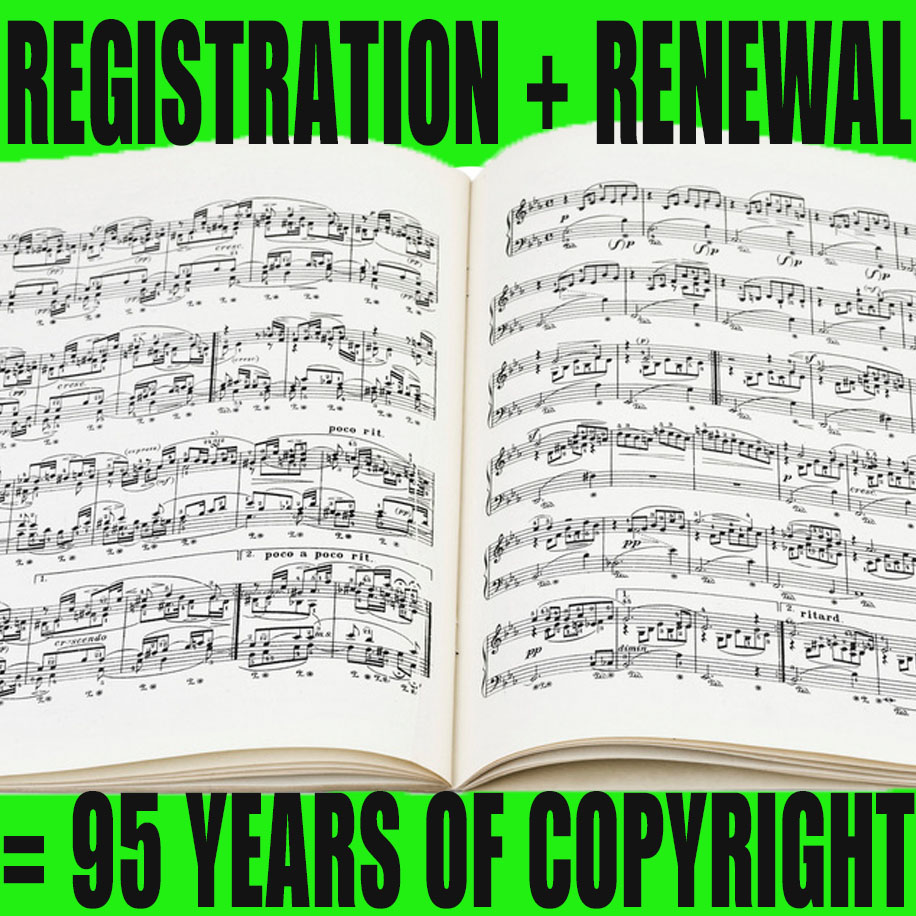
If the copyright was renewed, it’s protected for 95 years from the first publication. If the music was published in 1950, it wouldn't become public domain until 2045. It doesn't matter that the unpublished version was never renewed unless the unpublished version contains material that differs from the published version. For example, if the unpublished version contains an intro that's not present in the published version, the intro would be public domain.

Saturday, August 13, 2022

How Do I Locate Image Associated With a Copyright Registration?

Dear Rich: If I'm provided with a registration number for a visual art's copyright, how can I check its image? I have tried searching on www.copyright.gov, but the result doesn't include the image.
The Copyright Office Public Records Portal does not provide copies of the images, books, movies, or other copyrighted materials registered under copyright law. These works are considered deposit materials (because the registrant deposits copies with the Copyright Office), and you must request them from the Research and Certification Section. (Keep in mind that the Copyright Office does not retain all deposited works for copyright registration.) The Copyright Office will only provide deposit materials in three situations: (1) you are the copyright owner (and can prove it), (2) you are preparing for litigation, and you complete the Copyright Office Litigation Statement Form, or (3) A court order is issued for the deposited material. All of this information (and more) is provided in Copyright Circular 6.

Friday, July 9, 2021

Copyrighting Your Movie

Original Photo by Jeremy Bishop on Unsplash
Dear Rich: I need to copyright my new film. On-screen, I put “copyright 2021" along with a fictitious name. The name is not a recognized legal entity; it's a name for my business. I wonder if I can file copyright officially under my real name but somehow acknowledge the fictitious name without all the shenanigans of making the name a legal entity. Or can I use the fictitious name even though it’s not an official company? 
If you plan on using a fictitious name (also referred to as a DBA), you should check with your county clerk as to how to register a fictitious business name (or you can use one of the many DBA registration services online). The purpose of registering is so that the public can determine who owns a business. Most states only require sole proprietorships or partnerships to register if the fictitious business name does not include the names of the owners. If you're a sole proprietor (single business owner) and you are using a fictitious business name, you shouldn't have a problem registering the copyright. (This circular explains the basics for registering film.) When you file, list your real name as the copyright claimant (the owner of the copyright). 
What if a copyright examiner sees that the owner listed on the notice differs from the owner named in the application? Explain that you used a DBA (and furnish proof of registration, if necessary).
FYI - If you are using a pseudonym, review your options before filing. 
PS You have copyright without filing registering; it's automatic.

Monday, October 9, 2017

Fail to Register Song - Lose Copyright?

Dear Rich: I read that the government is planning a song database and songwriters who don't register will lose all copyrights. Can you explain?
The Transparency in Music Licensing and Ownership Act (TMLOA) is a proposed law that, should it be enacted, would create a song database run by the Copyright Office. Supposedly, the database would make it easier to locate the song owner or PRO. Note:  A song owner does not have to register copyright to provide information to the TMLOA database.
Failing to register. A song owner who fails to register will not lose copyright. The "punishment" for not registering is that if the song owner sues a store, restaurant, web radio, or other industries mentioned in the TMLOA, the song owner can only collect the actual damages, not the statutory damages or attorney fees. The underlying effect of the proposed law would be to discourage lawsuits against various industries. The TMLOA is not considered particularly favorable to song owners, and has been characterized as "an all-stick, no-carrot deal."
Bottom line dept. A few things to keep in mind: (1) ASCAP and BMI are cooperating on their own publicly accessible database in order to discourage passage of this legislation. (2) Regardless whether the legislation passes, any song owner who doesn't file for copyright before infringement occurs, cannot collect statutory damages. (3) Considering the track record for proposed copyright legislation, the cost and technology required, as well as the rumors spreading about the TMLOA, the odds disfavor passage of this partisan business legislation.

Monday, September 19, 2016

Someone Else is Registering My Trademark: What Do I Do?

Dear Rich: I attempted to register a trademark in 2005, which became abandoned by the USPTO in 2007 as I did not have the proper resources to complete the process. The trademark is associated with an event I have been producing since 2002, and as such, I believe I have common law rights to this trademark. I own the .com and the .org domains for this trademark, as well as the gmail account. Further, I have newspaper articles, t-shirts, and flyers which establish a solid first use prior to 2005. In addition, I have had an active .com domain site with the trademark since the early 2000's. I recently checked the USPTO because I now have the resources to resume the process of registering this trademark, only to find out that another organization is in the process of registering the same mark, in the same class, but for a different purpose. They offer a yearly conference, and their first use date is listed as 2013. My event is a charitable arts event intended to aid non-profits. The trademark has not yet been published, after which time I understand there is a window within which I could oppose their registration of the mark. (1) Do you recommend that I reach out to the organization and attempt to negotiate with them for their registration of a different mark? (2) Or do you recommend that I wait until the publication period (which I believe is next month), and oppose the mark via the USPTO? (3) Are there any strong exemplar materials you can direct me to to help me mount the best case for opposition? What about a template for a letter asking them to work with me on the registration of a different mark? (4) If I am successful with the opposition, or their cessation of the registration process for this mark, is there any strategy you would recommend to get a successful trademark registration on record with the USPTO despite the abandoned mark from 2007? i.e. Is there any chance that I could resume the registration of the original abandoned trademark under a different class? (I originally registered the mark in class 41, do you think class 35 would be viable since effectively the charitable event is meant to ultimately help non-profits thrive?) (5) If I hire an attorney for the opposition, what is the maximum amount of compensation you believe would be reasonable for taking on this particular matter? (6) Should someone else successfully register the trademark that I believe that I have common law rights to can they legally then ask me to stop using the mark? 
Even with our new Nespresso maker, we're not sure we're caffeinated enough to get through all of your questions. Let's start with some of the basics.
Your previous application. Your 2005 application was abandoned in 2007 based on a failure to file a proper trademark specimen. You cannot revive that application but you can file a new application and claim your original 2002 priority date. However the application you filed was for entertainment services, "namely, live performances by a musical band" which is typically used when claiming trademark rights for a specific band, not for an annual charitable arts event with multiple performers. So if you do re-file your application, you would want to tweak your explanation of services to make it clear you provide event services.
The other application. The other trademark owners filed their application in 2016 claiming the following services: "Organizing live exhibitions and conferences in the fields of education, culture, sports and entertainment for non-business and non-commercial purposes." From an examining attorney's point of view, their services -- as broad as they are -- may overlap with your event services. Their application has been approved for publication which should occur on October 4, 2016. If you file in a different class (Class 35 doesn't seem appropriate for your services), an examining attorney could: (a) possibly find the other application for the same mark, recognize the overlapping services and object to your registration; and/or (b) determine your choice of class is inappropriate and recommend refiling in Class 41 (which could prove expensive).
Opposing the other application. If you want to oppose the other application, you have thirty days to file a Notice of Opposition (fee: $300) on the basis that there is a likelihood of confusion. You can pay to extend that deadline up to 180 days. (It's possible an attorney may also advise that you file a trademark application which you would then reference in your notice of opposition.) You can file your notice of opposition electronically (and the USPTO has provided a manual explaining the procedure). The notice will require a response by the applicant and that will result in an inter-partes proceeding before the Trademark Trial and Appeals Board (TTAB), basically an administrative mini-trial.
Electronic filing basis for opposition
What's your best strategy? Unless you're familiar with legal proceedings and making legal arguments, opposition proceedings at the TTAB will likely require an attorney's assistance. You can read about typical TTAB actions at the TTAB blog, research TTAB final decisions, or you can search the TESS trademark database and click on the "TTAB status" tab when you find a registration that includes opposition proceedings. If you plan on contacting the other party before filing a Notice of Opposition, you should know what you're seeking beforehand  (a concurrent use application, a promise not to oppose your use within your region, a license, etc.) and you should keep your eye on the clock (so you don't lose the opportunity to file an opposition). Your best strategy will be determined after speaking with an attorney familiar with TTAB filings. We can't ballpark the cost of that representation although we're pretty sure it will cost more than your last root canal surgery.
Can the other applicant stop your use? Unregistered marks, even if they have priority, have limited rights versus registered marks. If you can prove priority you will probably be able to preserve your rights within the geographic area in which you have been operating ... but you won't be able to expand into other regions.



Wednesday, November 25, 2015

How Does Copyright Office Know Whether I've Published?

Dear Rich: I understand that the unpublished and published works have different fees and filing processes. But when I'm registering a not-yet-published-work, when is it OK to publish them on my website after filing? I heard it could take months for them to review/process the submissions. If I publish the work on my website a few weeks after mailing (or submitting) the copyright registration, how does the copyright office know that the work was indeed unpublished before I sent the application? Do they check the wayback machine or something? How do they verify that the publication date was indeed after the application has been submitted? Or should I simply file as a published work, since I'm planning to publish it soon? 
The Copyright Office doesn't verify whether publication has occurred; they take your word that the information you've provided is accurate. That's because you've promised (Section 8, Certification) that "the work identified in this application and that the statements made by me in this application are correct to the best of my knowledge." You can publish your work during the period that the application is being processed. However, the benefits of registration would not apply to changes made in the published version.
Should you wait? As a general rule, if you know that you will soon be publishing your work, it's better to wait until you've published before registering it. That's because the version that's published is typically the "final" version, that is the one that is unlikely to be modified. Registration within three months of publication guarantees certain rights. As always, we remind you that you have copyright in the work without registration. Don't operate under the mistaken impression that it's a race to the Copyright Office (or that you should mail yourself a copy) to claim priority over other similar works that are registered after that date.

Wednesday, September 23, 2015

Wants to Register Book With Antique Glass Negatives

Dear Rich: I have been collecting interesting antique glass negatives. Some I restored, others I changed artistically. I plan on writing a book of Haiku poetry and using the images from the glass negatives (50-100 of them). The dates of the glass negatives are from approximately 1860 to 1900. Some are from countries which match our copyright laws. The photographers are unknown. Do I have to apply for a copyright on each image separately or can I just submit the whole book for copyright (including the images)? 

We think you should wait until the book is completed and then register the copyright as a literary work, focusing on protection of your haikus. Registration of the imagery (the glass negatives) is more complicated.
Copyright in glass negatives. Even if the negatives are in the public domain (see discussion below), you would not be able to claim copyright if you simply restored the image. We think restoration -- though it requires great skill -- lacks the originality necessary to transform a public domain work into a registrable work. In the end it is closer to the "slavish reproductions" referenced in the Bridgeman Art Library case. As for the negatives that you "changed artistically," you may be able to register your modifications as a derivative work. And if you have several modified negatives you can register the modified collection as one registration, again assuming the works are in the public domain.
Public domain status. You can assume that the glass negatives are in the public domain if they were published before 1900. However, you can't make that assumption if the works were never published -- that is copies were never distributed for sale or loan to the public. Unpublished glass negatives may be protected in some cases for 120 years. As a practical matter we doubt whether you will hear from an angry centenarian photographer (or his or her estate) but the issue of whether the negatives are protected by copyright arises when seeking to register derivative works.
Registration process. The less expensive method of registration is to file electronically using the standard application for $55 (versus $85 for paper applications). It's possible that you can register both text and imagery on one registration provided they qualify as a single unit of publication. You can read the rules here (scroll down to "What Can Be Included on a Single Application?") As the sole author of the haikus, you can definitely register them as a single unit but we're not sure of the copyright status of the glass negatives (or what you've contributed) so we're unclear whether your modifications as a group merit a single unit registration for the whole book. And as we point out regularly, you obtain copyright regardless of registration; it's automatic.
P.S. Even it's not your birthday today, happy birthday.

Thursday, September 17, 2015

How Often Do We Register SaaS Software Copyright?

Dear Rich: I can't seem to find any recommendations for how to handle copyright registration of software that is changing frequently. Now that SaaS (software as a service - ed) software companies are publishing software updates weekly or even daily, it seems that the pace of copyright registration might not be keeping up. The copyright office was pretty noncommittal, suggesting that the safest route would be to register whenever the code changed "substantially." Care to take a stab at suggesting a 'best practices' cadence here?

We agree with the Copyright Office. Unless the code changes dramatically or unless you are offering features that are materially different from previous editions, it doesn't make business sense to register each weekly change. This is premised on the fact that the major benefits from registration -- statutory damages, the possibility of attorney fees, the ability to file a lawsuit -- are related to infringement disputes. Assuming the version of the software that is infringed contains the key elements and code that were previously registered, you could proceed with your dispute and reap the benefits of registration. Even if there were a gap between what was infringed and what was registered, you still own the copyright (it's automatic regardless of registration) and could, if necessary, expedite registration to incorporate the features (and claim the actual damages for infringements of those new features). In summary, register the key versions of your code -- those versions, which if infringed, would cause you significant damage.

Monday, June 22, 2015

Wants to Use Recycling Logo As Part of Trademark

Dear Rich: I started a small comic book publishing company called Disposable Fiction Comics, LLC. We are using the recycling logo as part of our logo. I know that the recycle logo is part of public domain, but I was considering trademarking it, but I started realizing that may not be possible as it would make it private property. 
The classic recycling logo -- three bent arrows in a triangle shape --has been used in many variations in dozens of registered trademarks from recycled fabrics to recycled metals to cement to photocopier cartridges to edible marijuana seeds. It even has its own design code at the USPTO (24.17.19 - Recycling symbol) which can be used when searching the USPTO trademark database.
How the USPTO handles the recycling symbol. The USPTO treats the recycling symbol as a "universal symbol"which is "any design, icon, or image that conveys a widely recognized or readily understood meaning. The USPTO advises examiners (Note: Word document download) that a mark using a universal symbol is registrable if it:
"... is highly stylized, if it incorporates elements that are not usually in the symbol, or if it is integrated with other matter in the mark, and, as a result, a distinctive commercial impression separate and apart from the symbol’s usual significance is created or a source-indicating unitary whole is formed."
In light of the registered marks, we believe that your use of the recycling symbol meets the standards described above. Hopefully, if there are no other impediments (for example, prior users in the same field of goods or services) or other registration issues, you should be cleared for takeoff.
None of our business dept. In light of the universally recognized meaning of the recycling symbol -- to designate recyclable materials -- isn't there a disconnect when you combine it with a word like "disposable" ("something designed to be thrown away after use")? Our re-branding suggestion is attached.

Monday, June 15, 2015

How Do I Register Revised Version of Previously Published Book?

early print-on-demand system
Dear Rich: Some years ago, I wrote a novel. I briefly offered it through a print-on-demand service, but only a very few copies were actually printed before I thought better of it and all of those copies went to me or close friends. The work was not registered with the Copyright Office at that time. Since withdrawing the book from the P-O-D service, I've made various revisions to the text, fixing some errors, refining dialogue, and so forth. I am now interested in registering the work, but because of the short-lived print edition, I'm not sure how I need to approach it. Am I obligated to submit the version published, noting the date, and then file a separate continuation with the revision? Is there a way to simply submit the current version and note that a previous, unregistered edition was published? (The current version is still close enough to the previous one to be immediately identifiable as a different draft of the same thing.) Yes, you can register the most current version but you might be better served by registering the earlier P.O.D. version assuming there are no major changes -- new characters, new plot line -- in the revision. Here's the skinny:
Do you need to register at all? Start with the principle that both versions are protected under copyright law and registration is not required to obtain rights. Registration is encouraged because it provides some benefits most of which are important if you must sue someone. Because few people have seen the P.O.D. version and nobody has yet to see your new version, you may not need to be concerned with infringement ... that is, until you distribute your revised version. 
If you do register ... The Copyright Office views your revised work as a derivative of the P.O.D. work and therefore your registration is intended to provide protection for your modifications. When you complete the limitations section of your application, you would fill it out as shown below:
Assuming the P.O.D. version is close to the revision, we would recommend registering the P.O.D. now. Later, when you are ready to publish the revised version, register that one as well, including the information shown above, as well as previous registration number and year of registration. Keep in mind that you can use your P.O.D. registration to stop someone who rips off your revised version (even if the revised version is not registered) because only the copyright owner (you) would have the right to make derivatives.
By the way dept. You would not file a "continuation." We think you're applying the patent definition of that term.  Under copyright law a continuation sheet is used to provide additional information that doesn't fit within the original paper application.

Monday, March 16, 2015

Should I Register My Domain Name as a Trademark?

Dear Rich: In your book on trademarks there is a discussion of whether you should register "trademark.com" as a trademark if you've already registered "trademark." The example provided is a line of menswear that is now also going to be sold online. The conclusion is that you should consider registering the full domain name (trademark.com) if establishing services or goods unique to the Internet business. Could you please explain why? If the PTO considers the ".com" piece of the trademark as unprotectable, what benefit would be gained by registering the full domain name? If you have a business that only sells online, should you register both "trademark" and "trademark.com"? 
If you register a domain name as a trademark with the USPTO, you won't be able to claim any rights to the ".com" (known as a top level domain or gTLD) by itself. The USPTO considers elements of the domain address such as "http://" and  "www." and gTLDs as unprotectable features of the website address. Although they are unprotectable by themselves -- that is, you can't stop others from using .com --  a mark that combines these elements with a protectable term is registrable if it is unique to an Internet business.
More than an address. The main thing to keep in mind is that you should register the .com if it is more than an address, that is if it is a source-indicating trademark use. For example, Zappos.com, an online footwear and clothing company refers to itself as "Zappos.com" at its site. In this way, Zappos.com, like Amazon.com, is more than an address on the web, it's the brand itself. (The USPTO's Trademark Examining Rules for domain names are located here.) The benefit of registering .com depends on the company. Some want a deep trademark portfolio, one that enables the broadest claim to trademark rights. Amazon has registered over a hundred "Amazon" marks and about 25 "amazon.com" marks (12 of which are still live). For smaller businesses, it may not matter much whether you register with or without the .com.
One more quirk. When registering a domain name, an applicant is permitted to furnish a drawing of the term within the address. For example, if registering Amazon.com, the applicant could furnish a drawing of the term "Amazon." (See TMEP Sec. 1215.02(c)))


Wednesday, July 30, 2014

Registering Copyright For Deceased Photographer


Dear Rich: My father, who died in 2008, was a talented amateur photographer in the 1950s and 1960s, and I’ve started to post some of his medium-format images online (none were ever published). I’d like to batch-register his images with the copyright office. I’ve registered many of my own images, but I’m not sure how to register images for someone who has died (I do have a copy of his death certificate, if that helps). Can you suggest the procedure? It sounds like you're already familiar with batch registrations of photos but if you need more information, read this circular. You'll have to do two registrations: one for published works, the other for unpublished works. When registering works for a deceased photographer, you would need to provide the photographer's year of birth and death. If you are the owner of copyright, you would list yourself as copyright claimant. Otherwise, list whoever it is who now owns copyright. You must also list how the claimant acquired copyright. On the electronic application there is a  drop down menu and one of the choices is "By inheritance." If that's accurate, choose that. Otherwise indicate how copyright was transferred. (Below are some screenshots of the online application).
FYI Dept. Your question reminded us of another photographer who is no longer with us. 

Wednesday, May 14, 2014

Is It Too Late To Register Copyright?

Dear Rich: I self-published a novel in September 2013. Is it too late to register my book with the Library on Congress? No, you (or your estate) can register any time that the work is protected (your life plus 70 years). If you register before an infringement occurs you can elect statutory damages and may be entitled to attorney fees. Also, you get a neat certificate. Although registration has its benefits, keep in mind that it is not a requirement for copyright protection.

Tuesday, October 8, 2013

Should I Use Digital Time Stamp Service?

Have the nattering nabobs
of negativism
 got ahold
of one of our readers?
Dear Rich: I'm a writer and illustrator who would like to be able to write some text, or draw a picture and immediately post it on my blog, but also retain a strong copyright position, all without paying $35 per posting to the U.S. Copyright Office. Would you recommend use of a copyright "timestamp" service (e.g., such as digistamp.com) to establish proof of authorship? Or would you just let the slimy scum scurrilous scribes of plagiaristic perfidy despoil the purity of your title to the children of your pen? If you're posting material to your blog, we can't see much use for digital time stamping. Your blog software records the date of publication (and probably even records history of uploads), and even if there are doubts about that, the pub date can easily be verified by online services such as Way Back Machine. The bigger question is why is dating the material so important?
Being first is overrated. We recently saw an ad for a casino that said "Understated is overrated." That was depressing but the truth is that in intellectual property, being first is really overrated. For example, it rarely matters in patent law because the U.S. has joined the rest of the world with its first-to-file system (and ditched the first-to-invent requirement). And being first is rarely an issue in copyright law, too. Like the quote goes, "if by some magic a man who had never known it were to compose anew Keats’s Ode on a Grecian Urn, he would [acquire copyright]." In other words, copyright protects independent creation, not being first. Timing only matters if, for example, you were an unknown songwriter claiming Britney Spears stole your song and her lawyers argued she couldn't have copied your song because your song didn't exist at the time she wrote hers.
Copyright registration? As you probably know, copyright protection is automatic. Registration before infringement helps determine how much you will recover (and ultimately is required for filing a lawsuit). But you should be able to maintain reasonable copyright protection without doing anything. How existential is that?


Wednesday, June 26, 2013

Should Actor Register His Name?

Dear Rich: I'm starting out as an actor. What's the best way to get a trademark on my name? If you are just starting out as an actor, you'll probably have a few hurdles to registering your name at the U.S. Patent and Trademark Office. Your big challenge is demonstrating that the public associates your name with acting/entertainment services -- a tall order for someone who's just starting out. The Trademark Manual For Examining Procedure (TEMP) explains the requirement here, and provides other details on registering performing artist names.  Also, you cannot register the name of a living person without their consent so you will need an affidavit for that purpose. (Here's an article we wrote about registering family names).
Do you need to register your name? Many actors have acquired trademark protection for entertainment services -- for example, Robin Williams, Clint Eastwood, Meg Ryan and Sandra Bullock. But the vast majority of actors don't register their names as trademarks (including Tom Cruise, Julia Roberts, and Dustin Hoffman)  because there's usually little need for trademark rights for movie actors unless they are offering a non-entertainment business such as a line of perfume or fish and chips. In addition, you don't need to worry about someone else registering your name. Living persons must consent to use of their name, so for example, the USPTO routinely prevents registration of well-known celebrities by profiteers seeking to cash in. Typically, actors find reasonable protection via actor's unions -- for example, one goal of the Screen Actor's Guild, (SAG) is to steer new registrants away from using any names that appear in their database (including derivatives, for example "Tommy Cruise").

Tuesday, May 7, 2013

Do I Register Book of Photos?

Dear Rich: I just created a small, self-published book of photographs to sell. I had previously registered with the Copyright Office all of the photographs in the book. Is there any reason for me to now register the book itself? Unless there's additional material such as text, illustrations, or a forward and you're concerned about someone stealing that, we can't see any reason to register the book of photos. As you may know, registration doesn't establish copyright (that's automatic), but it does provide you with additional benefits in the event that you're chasing an infringer. BTW, here's a video we prepared on how to register a group of photos.

Monday, March 18, 2013

Wants to Make Sexy Snow White

Dear Rich: I am planning to publish a book on Snow White and the 7 Dwarves that will be, shall we say, salacious in nature. I read Disney created a trademark for Snow White in 2010 but that it won't apply to written works. Even if their trademark did apply to written works, could I still publish my book? Or would it be considered a parody of sorts? Or, should I simply change all the characters' names (of course, readers would know who I was referring to all along)? Would that protect me from Disney's wrath? If not, do you have any ideas how to protect myself? Disney sought to register a trademark for SNOW WHITE in 2008. The application was for the exclusive right to use the slumbering superstar's name in connection with movies. The USPTO approved the application in April, 2010, but Disney never completed the registration process and as far as we can tell, the registration remains in hibernation awaiting that awakening kiss from Disney's legal staff. That doesn't mean Disney is backing off its IP chivalry, it just means it hasn't completed the process. You are correct in that none of the registrations filed by Disney are for printed matter (although the company does own rights to Sleeping Beauty bed linen -- clever, huh?). By the way, for the whole story of Disney's plunder of the public domain, check out this letter to European IP HQ.)
Right you had a question.  Legally, you're in the clear to create a book involving lubricants, handcuffs, and latex dwarf costumes, provided it's not based on or does not borrow from the Disney movie. You should probably include a disclaimer on the book stating that it is loosely based upon the original Grimm story and that is not affiliated with any entity that claims trademark rights to Snow White ... and of course avoid using the names popularized for the dwarves and which were created by Disney. Finally, you should avoid any visual reference to Disney characters, parody or not. Even if you do all this, that doesn't mean you won't get scary letters from Disney lawyers ... but your legal position should be fortified.
P.S. Here's a film that was made despite Disney trademark claims. Check out the director's response to a question about copyright and trademark.

Wednesday, January 2, 2013

Do Unregistered Trademarks Have Rights?

Dear Rich: I am planning on starting my first company, shortly. Currently, I am doing a trademark search, and ran into a Nolo article which states that "searching for unregistered trademarks is important because, even if a trademark is unregistered, its existence could prevent you from registering the trademark in your own name or from even using the trademark legally." How does a trademark have legal rights, if it is not registered with the USPTO? Also, if my trademark becomes registered, yet the prior user has his/her trademark still unregistered, would there be any way they could win the case, as my TM has rights, and their trademark does not? Yes, owners of unregistered (or "common-law") trademarks have legal rights within the geographic areas in which they operate. An unregistered mark can sometimes stop a subsequent federal user in the same geographic area. Or alternatively, a bigger company moving into an area may not be able to prevent a smaller competitor (whose use preceded the big company) from using a similar name. (Hence, Norman McDonald was able to continue to use his name on his hamburger stand in Philpot Kentucky though he had to remove his copycat arches.)
What gives them the right? Laws about unregistered marks are derived from a way-old English business principle: if someone attracts customers (goodwill) it is unfair for someone else to falsely pass off products or services with a similar trademark, thereby confusing consumers. Sometimes these state or federal laws are referred to as unfair competition laws, or unfair business practices. Famous unregistered trademarks can be protected under federal dilution laws. (Note, some functioning regional trademarks may not qualify for registration because they are not used in commerce regulated by the federal government -- typically, interstate commerce.)
The registration process. Some people believe that registration is the process of turning a name into a trademark. Actually, it's the opposite. You can't get a registration unless the name already is a trademark. Once your examiner is satisfied that you have a trademark, registration is granted and that enhances your already-existing trademark rights. Registration gives the owner a presumption of ownership, provides constructive notice to other companies in the U.S., and offers the hope of incontestability (after a few years). Registration may also increase your payment in case of a willful infringement.
The unregistered trademark. As noted, an unregistered first user of a trademark can often claim trademark rights within the geographic selling area. But keep in mind that having an unregistered name is not the same as having an unregistered trademark. You can't claim trademark rights, unless the moniker meets the legal requirements of a trademark --  that is it's distinctive and associated with your goods and services.
The way it is. All that said, nowadays, the tendency is to register as much as possible. That's partially attributable to the Internet: registration helps in domain name battles and the Internet has made made many regional (previously local unregistered) trademarks into national businesses. In addition, registration is now de rigueur for startups whose equity investors perceive it as adding value.

Wednesday, July 18, 2012

Does "Copyright Claimant" Mean Singular or Plural?

Dear Rich: I have a question regarding registering a group of songs. Circular 50 states that a group of unpublished songs can be registered on one application as long as "the copyright owner or owners" is the same for all songs. Circular 50 also says that a group of published songs can be registered with one application if all the compositions are "owned by the same copyright claimant." Does "copyright claimant" mean that it must be singular -- one individual or one entity -- or can it be co-owners as long as long as all the compositions are owned by the same co-owners? We called the Copyright Office and an information specialist informed us that a copyright claimaint could be plural (co-owners) as long as the co-owners are the same for all compositions. By the way, if you're willing to stay on hold for a while, you can always get answers to copyright questions at 202-707-5959 (or toll free at 877-476-0778). If you're willing to wait, you can get written responses within 5 working days here.

Friday, March 16, 2012

Do I Register for One Mark or Two?

Dear Rich: I would like to register a word service mark and a logo (which are the initials of the word mark) at the same time if possible. The word mark and logo are not used right next to each other on the website, however, or in any other promotional materials. From the research that I have done I think that he will have to register them separately, but I wanted to get a second opinion if possible. Second opinions are always a good idea unless the first opinion comes from our favorite MD (left). In any case, our hard working staff concurs with your first opinion. As the USPTO points out, "Only one mark is permissible per application, although a mark may consist of several elements that are joined to form a composite whole (e.g., words plus a design)." We took a look at your web page and we think that you have two separate marks -- not one composite design mark. So, two applications are in order. By the way, we discussed initials as trademarks in a recent entry.