Showing posts with label performance rights organization. Show all posts
Tuesday, August 26, 2014
Who Pays for Performance of Cover Songs?
Dear Rich: I’d like to start a top-40 band that will play mostly cover songs to make money while we work on our own material. I know that when music is performed, the owners and publishers of the songs played are entitled to be compensated for each performance of their song. When our band starts performing at colleges, weddings, and social clubs, who is responsible for obtaining performance rights and paying the royalties on the cover songs we plan to play? The venue, not the band, is responsible for paying for the public performance rights. Most venues have what are known as "blanket licenses" that permit performances of a wide range of licensed music for a fixed annual fee.
Monday, June 9, 2014
How Do I Register Cover Songs With BMI?
![]() |
| use Limelight when covering a song |
How do I register a cover song with BMI? You can cross that off your to-do list because you can't register a cover song with BMI or ASCAP. These performing rights organizations are for songwriters who are registering original songs. (They collect money when the song is played publicly). If you are covering someone else's song you would need a license from the owner of the song. Limelight is an organization that facilitates (for a fee) those types of mechanical licenses.
Wednesday, March 5, 2014
How Do They Know We're Playing Music in Our Store?
Dear Rich: We're going to be opening a pipe and tobacco store and want to play recorded music in it. The landlord for the building says that we will have to pay a fee to ASCAP. My question is if we don't sign up with ASCAP how would they ever find out about our shop? For over 70 years, performing organizations such as a BMI and ASCAP have employed people (unaffectionately referred to as "spies") to locate and report back on establishments that play recorded music. If one of these representatives frequents your tobacco shop, you'll soon get a letter from the respective organization. In other cases, a disgruntled employee or customer may report the establishment to a performing rights organization. Of course there are exceptions -- for example no license is required if your establishment is less than 2,000 square feet -- and we've provided an article with tips on avoiding ASCAP and BMI fees.
Wednesday, February 12, 2014
Why Can't I Play Cover Songs at Farmer's Market?
Dear Rich: I sing and play guitar (for about 50 years now). A few years ago I started playing and singing at a local farmer's market. About a month ago the manager of the market said I couldn't play cover songs anymore. ASCAP had contacted them and threatened to sue. I just assumed this wouldn't apply to me since I am not paid to play and the market does not advertise live music. I just play for tips ($10 - $20 for four hours!) and this is a public place. So, if I play out on the street corner in downtown Tucson is ASCAP going to threaten to sue me? Also, is there some kind of fee I could pay just for the privilege of playing copyrighted songs? [Disclaimer: Members of the Dear Rich Staff belong to BMI, ASCAP's rival.]
For those readers who are unaware, ASCAP is a performing rights organization/society (known as a PRO or PRS) that collects money from those who play songs in public ("public performance"). It then, in turn, pays the owners of those songs, typically a songwriter or song publisher. PROs collect money from malls, radio stations, TV stations, restaurants, and any other institutions or merchants who broadcast or perform songs from the ASCAP repertoire. Lately the PROs have begun to pursue an overlooked venue -- farmer's markets. Here's what a typical ASCAP letter might look like. The Farmer's Market Coalition is amenable to working out an arrangement but has balked at the stiff fees demanded by the PROs. The organization has retained legal counsel to look into the issue.
Will they pursue me? We're sorry to learn that your busking career has been so drastically altered, especially after having enjoyed the gig for several years. If you decide to return to the streets, we don't think you'll be hassled by a PRS. Performing right societies don't pursue individual musicians, they pursue and license the establishments where the music is performed. You can't pay an "individual" fee for performing cover songs because ASCAP only collects from the businesses, establishments or sponsoring organizations.
Isn't it unfair? That depends on who you ask. Your arguments -- you're not being paid, the market doesn't advertise live music, it's a public place -- may work for espousing free speech, but they don't line up with copyright law or commercial reality. The right to "perform" a song is controlled by the copyright owner. In any case, you're free to play music in a commercial setting as long as it's not ASCAP music. So your original or public domain compositions won't get anyone in trouble. Whether you get paid or not is of no consequence because the market benefits in the same way Urban Outfitters and Whole Foods benefits by presenting a more "pleasing" shopping event. (Note, slow music makes people spend more!) If it weren't so, the music would get turned off. (PS. The Dear Rich Staff is old enough to remember when you didn't have to listen to music when you shopped for English muffins!)
For those readers who are unaware, ASCAP is a performing rights organization/society (known as a PRO or PRS) that collects money from those who play songs in public ("public performance"). It then, in turn, pays the owners of those songs, typically a songwriter or song publisher. PROs collect money from malls, radio stations, TV stations, restaurants, and any other institutions or merchants who broadcast or perform songs from the ASCAP repertoire. Lately the PROs have begun to pursue an overlooked venue -- farmer's markets. Here's what a typical ASCAP letter might look like. The Farmer's Market Coalition is amenable to working out an arrangement but has balked at the stiff fees demanded by the PROs. The organization has retained legal counsel to look into the issue.
Will they pursue me? We're sorry to learn that your busking career has been so drastically altered, especially after having enjoyed the gig for several years. If you decide to return to the streets, we don't think you'll be hassled by a PRS. Performing right societies don't pursue individual musicians, they pursue and license the establishments where the music is performed. You can't pay an "individual" fee for performing cover songs because ASCAP only collects from the businesses, establishments or sponsoring organizations.
Isn't it unfair? That depends on who you ask. Your arguments -- you're not being paid, the market doesn't advertise live music, it's a public place -- may work for espousing free speech, but they don't line up with copyright law or commercial reality. The right to "perform" a song is controlled by the copyright owner. In any case, you're free to play music in a commercial setting as long as it's not ASCAP music. So your original or public domain compositions won't get anyone in trouble. Whether you get paid or not is of no consequence because the market benefits in the same way Urban Outfitters and Whole Foods benefits by presenting a more "pleasing" shopping event. (Note, slow music makes people spend more!) If it weren't so, the music would get turned off. (PS. The Dear Rich Staff is old enough to remember when you didn't have to listen to music when you shopped for English muffins!)
Tuesday, October 1, 2013
How Do BMI and ASCAP Co-Writers Register Songs?
![]() |
| dividing the songwriting pie |
- have your partner create a BMI publisher. We're aware that's' pricey -- $150 -- but that will allow each person to receive an equal split of both publisher and writer revenue from their respective PRO, or
- make your ASCAP music publisher entity the band's publisher and give your partner half of the income you receive from your ASCAP publisher checks.
Wednesday, September 4, 2013
Wants to Use Beautiful South Songs in Play
Dear Rich: I am a teacher at a secondary school and I want to write a play where I would charge a fixed price for tickets to the general public as well as the families of the children at the school. I am writing original dialogue but wanted to use the music of The Beautiful South in the play. I want a small band to sing and play the music live as well as use recorded tracks of The Beautiful South themselves. Would I need to ask permission or pay a fee for doing this? Technically, what you're seeking is known as grand rights, which refer to the right to incorporate songs into a dramatic or other narrative non audio-visual performance. We talked about grand rights in a previous entry. BTW, the composition of the audience or the price of the tickets typically has no effect on the legal issue as to whether permission is needed.
If you wanted to make sure the school is exposed to zero legal liability, you would contact the publisher (Universal-Island Publishing) and obtain grand rights permission (and if the songs were written by someone other than The Beautiful South, you would need permission from them as well). In order to reproduce The Beautiful South sound recordings -- for example, you wish to sell DVDs of the performance -- you would need the consent of the band's record label (previously Go Discs Ltd., a London-based label that went defunct). We think that will be a time-consuming (and ultimately fruitless) endeavor.
A simpler solution? Unless you're planning on doing more than a secondary school performance -- for example, you hope to exploit your idea off-Broadway -- you could give up on pursuing grand rights and simply categorize the use of the material as a public performance. Hopefully your school already has a license with performing rights societies such as ASCAP and BMI. In that case, the performances would be logged and paid for by the school. (It appears as if the Beautiful South is affiliated with ASCAP in the U.S. and PRS in the UK). If all this seems like way too much to deal with, you can simply proceed without permission and see if anybody objects. That low hassle approach involves more risk but may prove more sensible in light of your potential permission hurdles.
If you wanted to make sure the school is exposed to zero legal liability, you would contact the publisher (Universal-Island Publishing) and obtain grand rights permission (and if the songs were written by someone other than The Beautiful South, you would need permission from them as well). In order to reproduce The Beautiful South sound recordings -- for example, you wish to sell DVDs of the performance -- you would need the consent of the band's record label (previously Go Discs Ltd., a London-based label that went defunct). We think that will be a time-consuming (and ultimately fruitless) endeavor.
A simpler solution? Unless you're planning on doing more than a secondary school performance -- for example, you hope to exploit your idea off-Broadway -- you could give up on pursuing grand rights and simply categorize the use of the material as a public performance. Hopefully your school already has a license with performing rights societies such as ASCAP and BMI. In that case, the performances would be logged and paid for by the school. (It appears as if the Beautiful South is affiliated with ASCAP in the U.S. and PRS in the UK). If all this seems like way too much to deal with, you can simply proceed without permission and see if anybody objects. That low hassle approach involves more risk but may prove more sensible in light of your potential permission hurdles.
Monday, December 17, 2012
Dividing BMI Songwriting Royalties
Dear Rich So we have a band and we've done most of the formalizing to make it a real company and make sure everyone is taken care of fairly.
One of the things we've run into in trying to register our songs with BMI is that it wants the songwriter percentages.
We are a four piece and plan to split everything equally once we are profitable (until then, the money we make from the band helps fund the band so we can keep doing band stuff)
But as far as songwriters, that generally falls about 80% to one, 20% to another and all four contribute to the music composition.
Lyrics are credited to the band name. Again, everyone agrees to this.
But BMI wants people names and SS#'s, Tax ID #. You've said in some of your articles that the band can decide to split the royalties however they want, but how does that work from a practical standpoint if BMI wants to send checks to individual band members? Are the members supposed to sign the checks over to the band?
Also, it doesn't seem to be an option to register a band as a songwriter.
If BMI will only allow songwriters to be individuals, does that mean we have to have all members registered and credited 25% each so that it reflects our equal split band agreement? And then handle it internally (collecting from band members as specified in the band agreement until profitability is reached?) Performance royalties refers to the money collected by performance rights organizations like BMI and ASCAP and paid to songwriters and publishers. It's revenue derived from charging a license fee to businesses -- radio stations, stores, and taverns -- that publicly play your music. As we explain in our book -- Music Law: How to Run Your Band's Business
-- even if you set up a system whereby everyone (songwriters and nonwriters) shares equally in song income, it’s still possible that a credited songwriter will receive more money from BMI. That’s because in the case of performance royalties, BMI and ASCAP split the revenue for each song and make separate payments to music publishers and songwriters. In other words, with performance royalties the songwriter’s portion is paid directly to the songwriter and does not pass through the band’s publishing company. Therefore, if a song is a big hit on the radio or in a TV show, a credited songwriter will probably receive more money than a nonsongwriter. It is possible, as you suggest, that your agreement among the band (or between the band and the publisher) could deal with this share. For example, you could create a music publisher, register that with BMI and the publisher would receive half the income. Then, the songwriters getting checks could kick those into the pot as well. Alternatively you could forget the publisher and just have the members contribute their BMI income. These alternatives require some diligence and bookkeeping which is why it's often overlooked in band situations.
Monday, October 1, 2012
Terminating BMI for ASCAP: What Happens?
Tuesday, April 3, 2012
Do I Get Any Money From Cover Song Play?
Dear Rich: Our band covered a song and it's getting good airplay on Live 365 and at some other places. Do we get paid for this? How do we get the money? Most of the money generated from the playing of music -- whether on the radio, at an American Apparel store, or even on Internet stations -- is collected and paid to the songwriters, usually by performance rights societies. So, performing a cover song is usually not the best route to a guaranteed royalty stream. However, there is one way you can earn money for the public performance of your recording. Performers and record labels get paid for every performance of a song by a non-interactive webcaster – for example, Internet radio stations such as Live 365, Pandora, Sirius XM, Cable TV music channels, or virtually any digital transmitter in which the listener is unable to choose the specific song that's played. This money is collected and distributed by SoundExchange and you can sign up with them and list your tracks. The sign-up process is a little labor-intensive but once you are in their system, things should move smoothly.
Friday, September 23, 2011
Rights to Perform Show Tunes
Dear Rich: I represent some members of a theater musicians organization. My question is about transcribing theater numbers from a CD, and
performing them in public. Do we have to pay any copyright fees to anyone? Do
we have to pay the Tams-Witmark people
who own the rights to the music? Actually, the Tams-Witmark company doesn't own the musical performance rights to musicals; they control what are known as "grand rights," which refer to the permissions necessary to stage an opera, play with music, or a work of
musical theater. So, you need to consult Tams-Witmark if you are putting on the show, but not if you are only performing songs from a show -- for example, playing songs from The Wiz, Wicked or West Side Story.
BMI and ASCAP. Performance rights organizations such as BMI and ASCAP collect for such performances by charging venues with an annual blanket fee. So the venue ends up paying for it, not the musicians. The business of transcribing the music may technically require permission, but it is unlikely anyone will chase you for writing out the chord changes and melody of a song unless you attempt to sell these transcriptions.
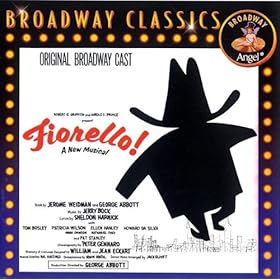
The Name's Laguardia. Can you believe that there was once a hit broadway show about Fiorello LaGuardia and it won the Tony and Pulitzer Prize? The Dear Rich Staff remembers it fondly (probably because we had the lead in one high school performance).
BMI and ASCAP. Performance rights organizations such as BMI and ASCAP collect for such performances by charging venues with an annual blanket fee. So the venue ends up paying for it, not the musicians. The business of transcribing the music may technically require permission, but it is unlikely anyone will chase you for writing out the chord changes and melody of a song unless you attempt to sell these transcriptions.
The Name's Laguardia. Can you believe that there was once a hit broadway show about Fiorello LaGuardia and it won the Tony and Pulitzer Prize? The Dear Rich Staff remembers it fondly (probably because we had the lead in one high school performance).
Subscribe to:
Posts (Atom)